Showing posts with label art. Show all posts

Sunday, May 1, 2011

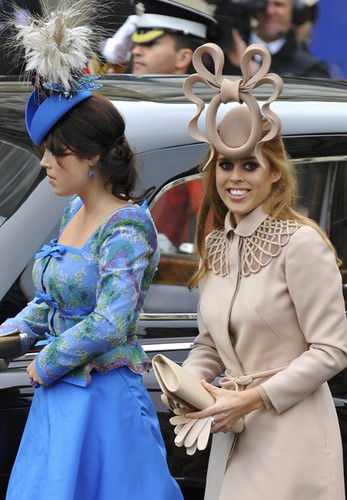
The True Horror Behind Princess Beatrice's Hat

beatrice silly hat


No, it's not a Cthulhu hat. No matter what the Today show says (do you have any idea how much what I just typed, burns. IT BURNS).

It is obviously a tiara from the Esoteric Order of Dagon, as described and featured in the Olmstead Manuscript, better known as "The Shadow Over Innsmouth." Compare with this example discovered in Peru. Or this one sighted in Spain.

As in soup, precision is everything.

Of course, the ramifications of this discovery are profound. For years David Icke has been railing on about how the royal family are a bunch of shapeshifting lizards joined together in a secret conspiracy. How about slowly transforming ichthyic-batrachian hybrid monstrosities? Hmm?

Sunday, February 20, 2011

Antiques Roadshow goes to Arkham


If you're wondering how Miskatonic acquires some of its more unusual pieces, this rare video from the Arkham episode of Antiques Roadshow (made available by member station Forbidden Donut Productions) may provide some answers.

Friday, November 26, 2010

Looking for a Necronomicon Cheap? It's a Buyer's Market


I don't have one, and I suspect the Ritman library, aka the Bibliotheca Philosophica Hermetica doesn't either, as it focuses mostly on the Christian Hermetic, Gnostic, alchemical, and other traditions, and other aspects of the Western occult tradition. And many of those works, currently housed together in the Bibliotheca Philosophica Hermetica in Amsterdam, may be split up on the auction block to cover the owner's debts. Some of the works there are quite important for these topics, and the current crisis was signaled by the offering for sale of The Grail of Rochefoucauld, the oldest account of the myth of King Arthur and the Holy Grail, a story still alive in our culture centuries later. If you want to check out more, or sign the petition if you believe it might help, check out The Wild Hunt's post on this for more info.

But seeing the troubles of the Ritman made me wonder what ancient grimoires and works of "occult poetry" might float about in economic chaos.

Update: The library is indeed being broken up.

Sunday, September 19, 2010

Chariots of the Elder Things? Nicholas Roerich's UFO

"Star of the Hero" Nicholas Roerich, 1932 (Wikicommons)

Over at his blog Mirage Men (the name of his recently released book Mirage Men: An Adventure into Paranoia, Espionage, Psychological Warfare, and UFOs, arguing that much of the UFO cultural phenomenon has been deceptive government activity), Mark Pilkington discusses Nicholas Roerich's UFO sighting. In 1927, Roerich and his team saw "something big and shiny reflecting sun, like a huge oval moving at great speed" in the sky. The sighting, before there was the idea of flying saucers or UFOs, may be the result of a joint Chinese and Swedish research team launching (you guessed it) weather balloons. You can read the account on pages 361 - 362 of the book Altai-Himalaya (excuse the difficult navigation system at the link), published in 1929

Roerich was one of Lovecraft's inspirations for At the Mountains of Madness, and he and his paintings of temples amidst the Himalayas are name-checked in the novella as a visual cue for the city of the Elder Things. In turn, the Elder Things, through Maurice Doreal, worked their way into the earliest stew of flying saucers, and the idea of a massive and/or ancient secret city of civilization involving UFOs in Antarctica has never dissipated.

Monday, September 6, 2010

Regnum Congo and the Horror of Theodor de Bry's Engravings

Exhibit EXH002: Pigafetta's A Report of the Kingdom of Congo (1881 [1591]).
In collaboration with Miskatonic University's Orne Library, Special Collections


One of the most infamous books referenced in the works of H. P. Lovecraft is Regnum Congo, the centerpiece of "The Picture in the House." Lovecraft did not read this book, written in 1591 by Filippo Pigafetta, titled in English, A Report of the Kingdom of Congo, and the Surrounding Countries, Drawn Out of the Writings and Discourses of the Portuguese, Duarte Lopez. Instead, he read Thomas Huxley's Evidence as to Man's Place in Nature, a page from which is reproduced above. But we can read a copy of Pigafetta's work. In it he does describe the Anziques as being cannibals. He does not find this that unusual in a global scale, but Pigafetta holds the Anziques to be unique in that they willingly cannibalize members of their own community. From Chapter 5
They have shambles for human flesh, as we have of animals, even eating the enemies they have killed in battle, and selling their slaves if they can get a good price for them; if not, they give them to the butcher, who cuts them in pieces, and then sells them to be roasted or boiled. It is a remarkable fact in the history of this people, that any who are tired of life, or wish to prove themselves brave and courageous, esteem it great honour to expose themselves to death by an act which shall show their contempt for life. Thus they offer themselves for slaughter, and as the faithful vassals of princes, wishing to do them service, not only give themselves to be eaten, but their slaves also, when fattened, are killed and eaten. It is true many nations eat human flesh, as in the East Indies, Brazil, and elsewhere, but to devour the flesh of their own enemies, friends, subjects, and even relations, is a thing without example, except amongst the Anzichi tribes.
Today, the people referred to as Anziques are the BaTeke, living in the Republic of Congo, the Democratic Republic of Congo, and Gabon. They are part of the Bantu language family. And as is usually the case with cannibalism stories, they came to European chroniclers from unfriendly neighbors, making the veracity of such claims doubtful without additional evidence.

But this did not stop the reproduction of the stories, and especially the image for centuries. Engraver Theodor de Bry created the image which so impressed Huxley, and in turn inspired Lovecraft's tale of backwoods New England cannibalism. Illustrations by de Bry have become some of the most reproduced in portrayals of European exploration in the 16th century. He worked with reports from various travelers and chroniclers, such as John White (check out this section of Virtual Jamestown for comparisons, commentary, and more) but did not actually journey to Africa or the Americas himself. Nonetheless, his fascinating and at times disturbing imagery shows up again and again in both popular and scholarly presentations. His studies of the native of Virginia are very commonly used, and can be viewed at several online galleries, such as this one from the University of North Carolina Libraries.

Theodor de Bry also illustrated an edition of Bartolome de las Casas' A Brief Account of the Destruction of the Indies, an influential polemic against Spanish cruelties in the American colonies. These images are amongst the most horrifying de Bry ever produced, which is saying something, putting the centerpiece of "The Picture in the House" to shame. The book and the engravings were instrumental in establishing The Black Legend against the Spaniards, which portrayed them as monsters sacking the New World through mass torture and murder. There was indeed plenty of cruelty and destruction, but it is worth noting that the propagandistic emphasis on horrible Spanish excesses served political purposes in the national and religious wars of the 16th and 17th centuries, and even up through the Spanish Civil War to the present. The nations pointing out Spanish atrocities would have their own massacres and ethnic cleansing in colonies in North America.

I myself had an experience which calls to mind "The Picture in the House." Prior to my work with the archaeology of the Spanish Conquest, I was conducting prehistoric archaeological excavation in El Salvador. I had brought with me, amongst a handful of other books, a copy of Charles Hudson's Knights of Spain, Warriors of the Sun: Hernando de Soto and the South's Ancient Chiefdoms, which featured some of the de Bry illustrations from las Casas. This engraving in particular horrified me.


Cannibalism was also depicted, but for some reason the bits of people, and especially the anguished flailing of the maimed, bothered me at a core level. I knew that the taking of noses and ears was a common punishment for rebellion in feudal Europe, and that added to the reality of the horror depicted. For the remainder of my stay during that project, a period of several months, this image gnawed at me. I tried to avoid it while finishing the book, yet every so often felt compelled to seek it out, as if confronting the image would take away some of the fear that had gripped me. Only once out of El Salvador, and the claustrophobic apartment I lived in, and with many other books and other media, did the image's effect dissipate. Today it does not bother me in any undue fashion. But at the time, during a time period when there was great uncertainty in my life, and I felt somewhat trapped in situations not of my making both in a foreign land and in my larger life, de Bry's imagery chilled me to the core.

Thursday, August 5, 2010

The Moche Octopoid Headdress - A Representation of Cthulhu?

Exhibit RLY003 - Moche gold octopoid hybrid headdress, possibly from La Mina, Jequetpeque Valley* In 1988, looters robbed a rich tomb at La Mina in the Jequetepeque Valley of north coastal Peru. This tomb was left by members of the Moche archaeological culture, a series of sites and artifacts participating in shared material culture, and especially an expressive iconography and art style for most of the first millennium AD. Tomb looting is rampant in Andean archaeology as it is elsewhere, but this is exacerbated in the case of the Moche because of the excellent preservation (much of coastal Peru is quite dry, and organic materials are found at many sites) and because Moche metallurgists were skilled in working gold, a substance that drives the most primal dreams of treasure hunters. In 2006, a gold Moche headdress was recovered in London, believed to derive from the La Mina tomb and looting. Police worked with an international art dealer to locate and take possession of the headdress, valued at possibly almost one million pounds (over 1.5 million $US). As of 2006, British authorities were working to return the object, described by some as the Moche Mona Lisa, to Peru. The headdress has been described as a sea god or goddess, an octopoid creature with a human/feline mixed face. Most Moche depictions of octopods portray the suckers with lines of dots or circles. In this case the triangles on the tentacles are more like those attached in Moche painting to the frill of an iguana or along the sides of a snake, perhaps suggesting a scaly surface, thought they are also found on fish fins, such as in the depiction below. The ends of the tentacles suggest mouths, similar to serpents often found protruding from figures in Moche artwork. Anthropomorphizing animals and objects was common in Moche art, as was combining elements of different creatures. Likewise, marine subjects were common in Moche art, dominating many scenes in the corpus of fine-line painted pots that make up the most important databank we have for elite Moche intellectual and religious concepts. Much of the background information here is found in Christopher Donnan and Donna McLelland's 1999 book Moche Fineline Painting: Its Evolution and Its Artists. Intriguingly, a marine hybrid creature more commonly depicted than the octopus is one Donnan and McLelland label 'The Demon Fish." Resemblances to stories of mermaids or fish humanoids elsewhere in the Pacific or off the coast of Massachusetts are plain.
Demon Fish, from Donnan and McLelland 1999:
The Demon Fish is one of many anthropomorphized marine creatures, carrying a tumi metal knife for ritual combat, throat slitting, blood drinking and decapitation for trophy heads. This mythologized activity in Moche artwork is reflected in a number of archaeological discoveries. Probably the most infamous example is the Huaca de la Luna (a huaca is a general Andean term for prehispanic ritual sites) at the Moche type site, where multiple sacrifice or execution events left behind individuals in positions suggesting they were bound, and showing not just cut throats, but horrific wounds across the body. Bioanthropologist John Verano has suggested that the placement of cut marks on bones, when compared with other Moche artwork, suggests that some bodies were defleshed but not dismembered, and were hung in a fashion not unlike windchimes. Comparison can be made with Inspector Legrasse's early 20th century report on the Cthulhu Cult in Louisiana, and their hanging of bodies for some undescribed creature that the adherents told police would attend their ceremonies. Perhaps there is some parallel in the Decapitator, the name given to a supernatural figure that appears in Moche artwork associated with these rituals. This entity often had arachnid elements

What are we to make of this headdress? It is gold or a gold alloy, depicting a bizarre sea creature. Compare with Robert Olmstead's description of a tiara in the possession of the Newburyport Historical Society when he visited Massachusetts in 1927, as described in the narrative "The Shadow Over Innsmouth," by Howard P. Lovecraft
"It was tall in front, and with a very large and curiously irregular periphery, as if designed for a head of almost freakishly elliptical outline. The material seemed to be predominantly gold, though a weird lighter lustrousness hinted at some strange alloy with an equally beautiful and scarcely identifiable metal. Its condition was almost perfect, and one could have spent hours in studying the striking and puzzlingly untraditional designs - some simply geometrical, and some plainly marine - chased or moulded in high relief on its surface with a craftsmanship of incredible skill and grace."

That object was a prime example of Marsh Gold, a scattered series of eccentric jewelry pieces turning up in New England between the mid-19th century and the 1930s. The artist or workshop is unknown, but local folklore associates the pieces with the Marsh gold refinery in Innsmouth, Massachusetts, shuttered in 1927 after a federal investigation into alcohol bootlegging. Stories have swirled around the gold for decades suggesting it came from a pirate hoard found by Captain Obed Marsh during his trade expeditions in the 19th century Pacific. Prehispanic artifacts have been recovered from sunken Spanish ships, and such shipments were the prime target of pirates. If the Marsh Gold objects could be demonstrated as having ties to Andean art traditions, perhaps Marsh did indeed find some pirate loot left over from the days of the Spanish colonial empire in the Americas. In light of the octopod-human-feline gold headdress, its similarities to the Marsh Gold, and prominent elements of supernatural anthropomorphic "Demon Fish" in Moche art, perhaps the geographical context should be examined. 

The above map displays several items of significant interest. The rough location where the headdress was believed to have been looted is noted on the South American mainland. To the southwest, we can see the rough location of the biologically emptiest spot in the ocean, waters exceedingly clear because they are more devoid of life than other areas of the open oceans, as discussed in a previous exhibit. South of this area we find the triangulated position of "The Bloop," an acoustic phenomenon to be discussed in a future exhibit, and the rough location of the mystery island, called R'lyeh by some, described in the Johansen Diary. These locations roughly outline the area suggested by theosophist James Churchward for the southeastern tip of sunken Mu, but as Lovecraft noted,

Theosophists have guessed at the awesome grandeur of the cosmic cycle wherein our world and human race form transient incidents. They have hinted at strange survival in terms which would freeze the blood if not masked by a bland optimism.
*note: while the information about the Moche is accurate, discussion of the Marsh Gold, Innsmouth, Inspector Legrasse and his investigations of the Cthulhu Cult are for edutainment purposes only

Sunday, January 10, 2010

The Nicholas Roerich Museum

Added a link to the Nicholas Roerich Museum, where you can see the paintings name-dropped in stories like At the Mountains of Madness. Roerich was, in addition to a painter, a Theosophist mystic, an archaeologist, and an activist for protecting world heritage. Lovecraft visited the Roerich Museum, located in New York in 1930.

Friday, November 6, 2009

The Case of Claire Nolan

Exhibit WIT001 - Portrait of Dame Alice Kyteler (images at links below)

Author has "uncanny" resemblance to unrelated hypothetical portrait of the subject of her relatively obscure book. This wouldn't be terribly interesting, except that the subject, Dame Alice Kyteler, was accused of witchcraft, including the poisoning of three husbands.

Someone please direct Ms. Nolan to "The Case of Charles Dexter Ward," ASAP.